Archives - Page 7
-
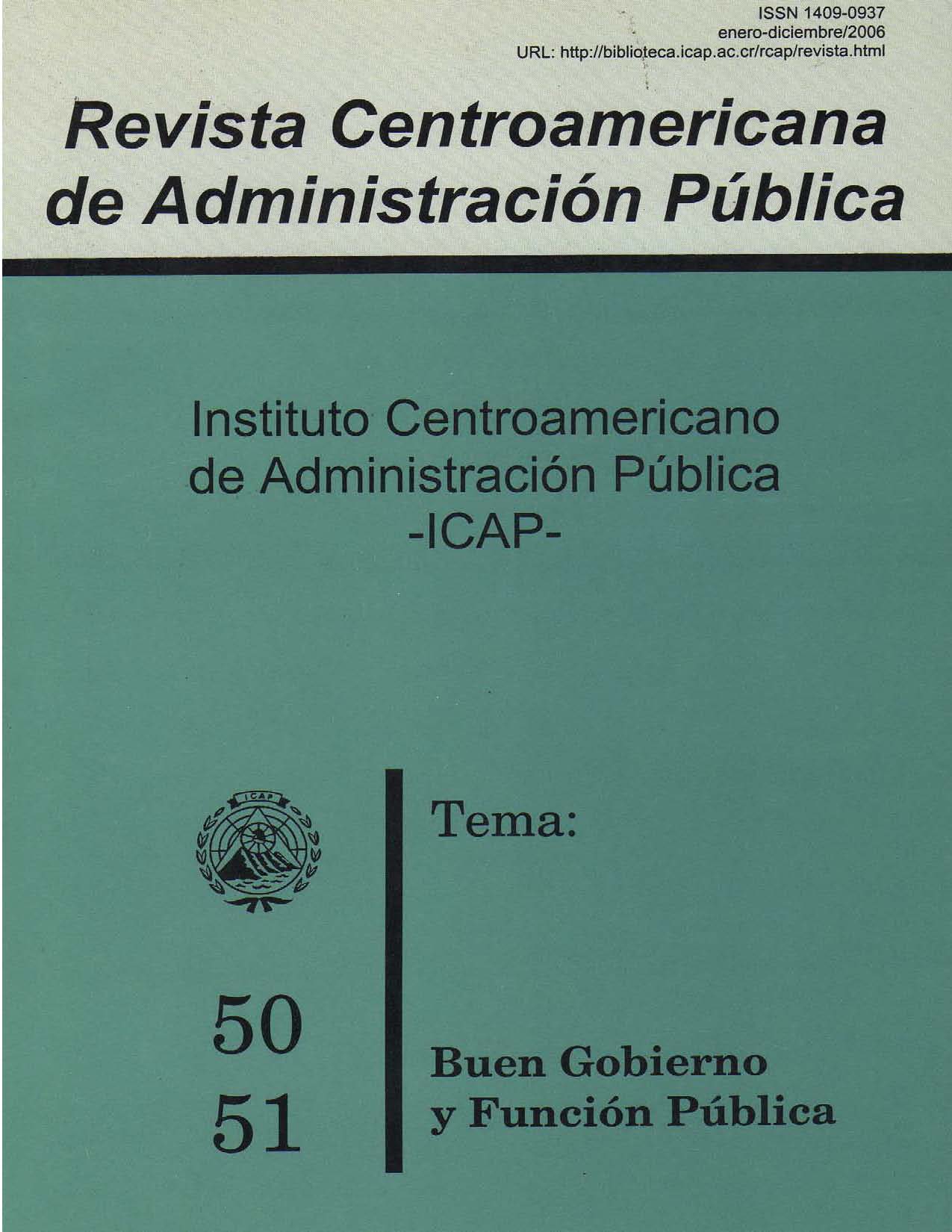
Buen Gobierno y Función Pública
No. 50-51 (2006)The development of governmental institutionality in the countries of the Central American Isthmus has responded to significant milestones in the construction of national States, with the creation of Civil Services and Administrative Careers, today popularized in the conceptual jargon as public function, being of singular importance.
Within the framework of the current modernization of public administrations in the Region and the social, economic and political changes, both domestically and globally, the quality of public service and good governance have become important assets for Central American society.
In this sense, some authors have considered that having a professional corps of public officials is a "common good" of great relevance to face the challenges of the countries of the Area. Particular examples of public administrations with a merit system for government officials have illustrated the contribution of a proven and well-qualified technocracy to the competitiveness of countries, the satisfaction of social demands, governance, transparency and sustainable development.
Thus, within the framework of these ideas, some of the relevant aspects that this topic has currently taken up in the global context are as follows:
-In the framework of the democratization and modernization processes undertaken by the governments of the Region, with the civil service becoming a fundamental element of the rule of law and of the processes of participation and democratic deepening.
An important basic characteristic of "good governance" initiatives is to rely on the institutionality of the civil service, as a body of civil servants at the service of the public administration, responding to a merit-based system, oriented to the service of the citizen, and capable of meeting the needs of society with quality.
-Recent studies on the competitiveness of nations in the context of economic globalization have shown that one of the success criteria of countries that have achieved insertion in the world economy, as well as a certain degree of sustainable development, has been due, to a certain extent, to the existence and institutionalization of a professional bureaucracy, with a meritocratic profile, well informed and with a certain capacity of autonomy to promote public policies for the collective welfare.
-Currently, the modern trend of the new public management is to consider an efficient and effective public administration as a national asset and/or a "quality public good", to promote the economic, social and political development of the countries of the Region.
With these considerations, the Central American Journal of Public Administration is honored to dedicate issues 50 and 51 to the topic of "Good Governance and Public Function.
-
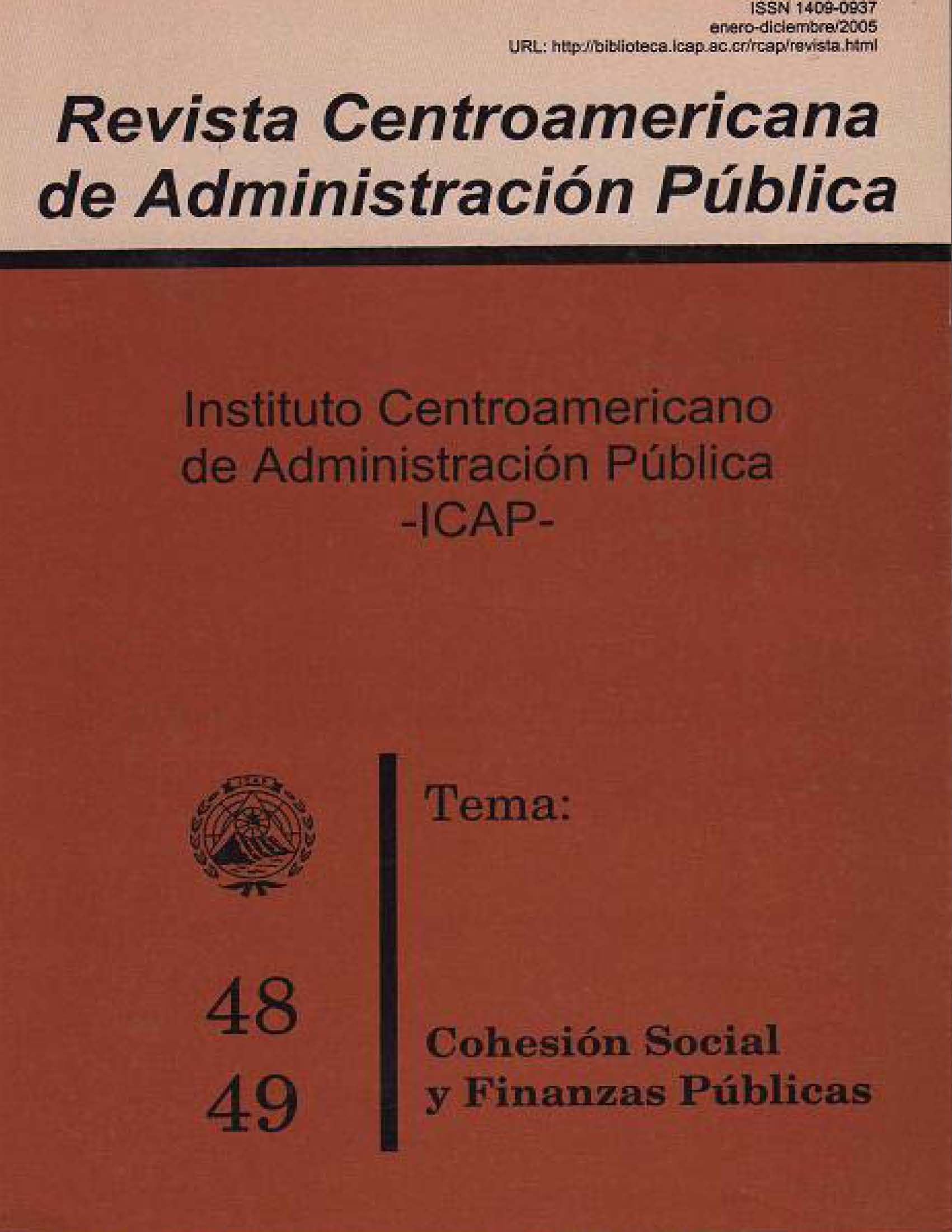
Social Cohesion and Public Finance
No. 48-49 (2005)The emergence of the term "Social Cohesion" in the conceptual jargon appears approximately two decades ago. However, in our region, it has emerged with great force in recent years. Thus, in 2004, at the Guadalajara Summit in Mexico, the Heads of State and Government of Latin America and the European Union reiterated their primary responsibility, together with their civil societies, to lead processes and reforms aimed at increasing social cohesion by combating poverty, inequality and social inclusion. These agreements, reaffirmed at the Vienna Summit in 2006, opened up a new field of cooperation in political relations of solidarity between the two regions.
This topic becomes relevant for Latin America in general, and Central America in particular, due to the urgent need to address pertinent problems concerning: high rates of poverty and indigence; extreme inequalities; different forms of discrimination and marginalization; labor market dynamics with scarce inclusive capacity; population with high levels of deterioration in basic rights, such as health, education, aging; transformations and new orientations in families and communities, to mention, among others, some current social challenges. Hence, its recent appearance in dominant aspects of the Region's public agendas.
Social cohesion is a concept under construction, with diffuse scopes, not always agreed upon, whose close notion is social capital. It is indifferently associated with different aspects of social development, incorporating within its scope general problems of poverty, inequality, social exclusion and governance. Its conformation from the theoretical-practical study, is acquiring a greater profile of identity and depth, pretending to become an unmistakable reference in the design of public policies.
Notwithstanding the above, the growing usefulness of the concept is perceived, presenting a series of edges and interrelation in countless aspects of social, economic and political development, evidencing the tensions between the close links between these three dimensions, because economic exclusion generates political separation, which in turn, increases inequality and endangers social justice, causing unrest and discontent among society, and violating the solidity of the democratic order.
Hence the relevance of the relationship between social cohesion and public finances, by operationalizing it in concrete terms of government resources and financial allocations, aimed at rethinking social protection on the basis of universally recognized rights, through policies, programs and projects that contribute to improving the welfare of our populations.
These reflections invite us to begin to examine how to strengthen social cohesion in the Region by means of guidelines that seek its viability, by acting on the obstacles that prevent progress towards effective citizenship, the horizon on which the significant concern of this topic makes sense.
-
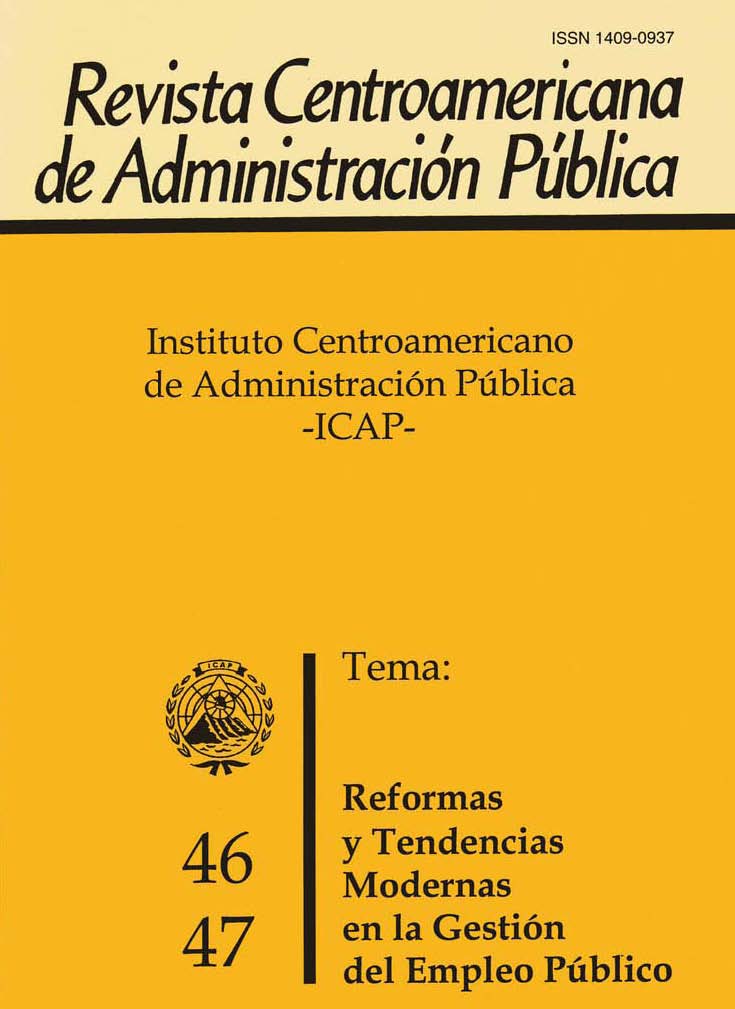
Reforms and Modern Trends in Public Employment Management
No. 46-47 (2004)State Reform programs in Central America include among their agenda items, support for the creation and revision of the existing Civil Service Systems in the Region. This topic acquires relevance in the framework of the democratization processes and the rule of law, as the Civil Service Regime contributes to deepen the institutional framework that guarantees the professionalism and objectivity of public officials, including respect for the principles of equality, merit and stability.
In this sense, the "XII Meeting of Directors of Civil Service and Human Resources of the Central American Isthmus: Civil Service Reforms in Central America and Modern Trends in Public Employment Management", organized by the General Directorate of Civil Service of the Secretariat of State of the Presidential Office of the Republic of Honduras, jointly with the Central American Institute of Public Administration, ICAP, in its capacity as Technical Secretariat of the Meetings of Directors of Civil Service and Human Resources of the Central American Isthmus, and held from July 27 to 30, 2004, in Tegucigalpa, Honduras, had the purpose of reviewing the modernization efforts promoted by government authorities in this area, whose debate and comparative analysis provided the following lessons:
- The advances in the revamping and strengthening of the Civil Service Systems in the Central American area are still relatively modest.
- The concept of Civil Service admits multiple interpretations, and its application has given rise to the design of a variety of institutional systems, which are related to different theoretical and cultural traditions.
- The notion of civil service is nowadays more relevant, since it has a double dimension, referring both to a management sphere and to the body of personnel that performs it.
- The Civil Service contributes to increasing the quality of public policies, which require a degree of professionalism, expertise and stability of a set of technical-administrative human resources.
- The importance of the Civil Service is manifested in the continuity of management, and in the capacity to respond to the increasingly growing and complex needs of the Central American population.
In the current context of the challenges of transparency, productivity and satisfaction of social demands, the Civil Service appears as a priority institution to safeguard the credibility of the effectiveness of the democratic State. However, in its reform process, important dilemmas arise, which the governments of the Area have to address in order to retake the sense of institutionality in public administration, as can be seen in the material presented in these two issues of the ICAP Journal, which we make available to our readers today.
Translated with www.DeepL.com/Translator (free version)
-
Modernization of public finances
No. 44-45 (2003)Since the 1990s, the public finance sector in the Central American region has been promoting the modernization of the financial management of public institutions, a process that has developed in phases according to the budget cycle. This trend has shown the strengthening of this sector in different countries and its manifestations have been diverse and its results varied.
Some of the purposes of this strengthening of public finances in the area are to make it possible to bring the payment of contributions, the demand for services and the provision of those services resulting from this collection closer together, as a means of making the management of the public treasury more transparent and efficient, generating savings and providing greater need for responses to the national population.
The reforms introduced reflect changes in budgetary accounting systems. Thus, the growing commitment of public administrations to show greater transparency in the allocation and application of public resources has led them to adopt alternative budgeting, spending and accounting schemes that are fundamentally oriented towards obtaining results and have the capacity to generate solid information systems.
In this sense, the Organization for Economic Cooperation and Development (OECD) has identified seven criteria to appropriately undertake the objectives of budget modernization, whose reforms, in a sequential manner, include the following:
*Macro-fiscal rules
*Multi-annual budgeting
*Strategic planning of public agencies
*Relaxation of internal controls
Accounting and management on an accrual basis *Relaxation of internal controls *Relaxation of internal controls
*Performance evaluation
¨*Performance agreements
Some of these measures have already been implemented in Central America. Their most relevant effects, which are not yet fully appreciated, is the beginning of important processes of reflection and analysis on the type and form of management with which public entities exercise their competencies, which are obviously projected in the medium term, but are those that can ultimately ensure better performance to meet collective needs.
Hence, the importance of making a call to the urgency of continuing with the improvement of the governmental financial administration, as a way to contribute to a correct procurement and allocation of public funds, for a better welfare of the community.
These readings that today the Central American Institute of Public Administration, ICAP, makes available to its readers, are a recognition of the efforts made by their authors, as a positive contribution to the trend towards an invigorated public administration, which allows a better coexistence in the Central American Isthmus.
-
Administrative careers and governance
No. 42-43 (2002)The issue of governance is currently at the top of the global agenda. Its raison d'être is the examination of governmental deficits in an environment of unprecedented speed of change, which requires institutions to adapt to new rules in order to respond to society's demands.
Its notion has become intertwined with the concept of good governance, with the idea of the rule of law and democratic institutionality.
It is associated with a minimum characteristic of effective and efficient management by the State, which is why public administration is one of the essential instruments for the governance of a country.
Therefore, the intention of helping to raise the quality of public action, through the strengthening of society's own capacity for self-government, are aspects that can undoubtedly be decisive in the arduous task of building an environment favorable to stability and development.
In this sense, the Inter-American Development Bank, IDB, has been reiterating in recent years that "there is a direct relationship between economic development and the quality of the governance process". Therefore, governance and development are interacting factors, and institutional development is an essential component of it.
Efforts in this regard have been crystallized in the framework of State reforms, aimed at revising public organizations, both horizontally and in the context of sectoral areas, with particular relevance to reforms of public employment in general and the Civil Service and Administrative Career, in particular.
Consequently, the civil service, the Civil Service and the Administrative Career constitute government policies that lead to an explicit recognition of their relevance, in relation to the fact that they are essential instruments to help democratic governance.
Hence the importance of the Seminar on Administrative Careers and Governance, which took place within the framework of the "XI Meeting of Directors of Civil Service and Human Resources of the Central American Isthmus", promoted by the Forum of Directors of Civil Service, jointly with the Central American Institute of Public Administration, ICAP, in its capacity as Technical Secretariat, held in Panama, Panama City, from August 20 to 23, 2002, with the fundamental purpose of opening a debate to retake the sense of institutionality in the Central American public administration, whose contributions we make available to our readers today.
Translated with www.DeepL.com/Translator (free version)