
Archives - Page 11
-
Political and administrative decentralization
No. 18 (1990)The welfare State, characterized by a strong interference and intervention in the economic and social fields, tended to promote policies aimed at strengthening national development through the creation of autonomous institutions in charge of performing specialized functions in specific services.
The proliferation of these bodies and the absence of balanced institutions of public power gradually led the Legislative to hand over more functions and powers to the Executive Branch, turning local governments into the appendix of this power, which led to the inactivity of the municipalities and the decline of the representative function of the communal interests.
The loss of local power and the lack of basic guidelines of the Legislative with respect to municipal autonomy, constitute fundamental factors of analysis that diagnose the local reality, necessary to propose the relative changes that such regime requires, and to make possible the relaxation of the centers of power, facilitating citizen participation.
On the other hand, the strengthening of the central level and the consequent weakening of political-administrative decentralization constitute current problems that require processes of change to promote important decentralization options to transform the state apparatus and achieve citizen participation in the management of public affairs.
The current social dynamics of Central American countries and the political opening, manifest a will to carry out processes that strengthen the faithful and democratic representation of local governments, by means of popular participation, as a response to the economic-social and political crisis.
From this point of view, the strengthening of local governments and political-administrative decentralization is currently expressed as the right and capacity of communities to order and manage an important part of the public affairs that concern them, within the framework of the law, under their own responsibility and for the benefit of their own localities.
It is in this context that ICAP dedicates this issue to political and administrative democratization and to Local Governments, to invite them to reflect on the problems and optional measures of practical action, for the benefit of the strengthening of citizen participation.
-
Public policies: methodological approaches
No. 17 (1989)Since the 1970s, public policy analysis has gained great importance for academics, technicians and politicians.
One of the factors that has contributed the most to this fact is, without a doubt, the so-called crisis of the Keynesian State or Interventionist State. What for some analysts had constituted the possibility of achieving a rationalization of society that would guarantee the social cohesion and integration that the market had not been able to achieve, became a factor of systematic crisis. For others who, as Gouh points out, identified the policies of the "Welfare State" exclusively with private interests linked to large corporations, during the crisis, they found themselves in the paradox of defending state interventionism. Both have been forced to redefine their approaches. Thus, we find that the former, from different points of view, have felt obliged to recognize the diverse and multidetermined nature of public policies, while at the same time striving to develop a series of evaluative "technologies" that seek to provide decision-making and policy management with greater rationality.
The second group, who have a more critical perspective, have recognized not only that state policies are a historical result of struggles and compromises between classes and social sectors, but also that internally a series of factors of various kinds (organizational, administrative, etc.), located in what Foucault has called the "microphysics of power", weigh heavily, which, without being determining factors, do condition the formulation and application of policies.
This has led to new conceptions of the State and politics, and to greater concern for understanding the dynamics of these realities, leading to the incorporation of heterodox and diverse perspectives in terms of the dimensions that are incorporated into such analyses.
-
Development financing
No. 16 (1989)The crisis affecting the Central American isthmus has accelerated the process of irruption into social and political life of traditionally dominated groups, has created favorable conditions for the spread of modern ideologies, but has also allowed conservative political conceptions to express themselves directly or covertly under new political-ideological garb.
Overcoming the crisis represents a challenge that affects the content and scope of public action in each of the countries of the region, especially in terms of finding formulas for solving medium- and long-term financial problems. Central America needs international financial resources, and at the same time it must make a better internal allocation and use of its own and international resources to obtain the greatest impact in the execution of stabilization, reactivation and economic development policies, as well as social welfare. Central America requires better payment conditions for its absolute external debt.
External financial resources are partially blocked by the conditions established by international financial organizations, especially those related to the payment of interest and overdue amortizations of the external debt and the need to advance in structural adjustment programs.
Central America has internal financial resources, but in several countries the owners of these resources only make them available to a minority of businessmen and financial intermediaries or invest them abroad; there are even cases in which these owners demand that they be given access to financial resources obtained from abroad. In view of this, some Central American governments have adopted measures to improve the collection and channeling of credit, one of them being bank nationalization.
Central American businessmen are facing a market problem, so the reactivation of regional economic integration and the opening of export possibilities to the US and Europe become the tasks of the moment.
Negotiations on the payment of the foreign debt and the possibilities of obtaining additional financing is one of the main concerns of the Central American governments.
Given the importance of these issues, the Central American Institute of Public Administration has decided to dedicate this issue of its magazine to Central America: Financing for Development.
-
Public health policies
No. 15 (1988)The Central American Institute of Public Administration (ICAP), the only regional center whose objective is to improve the public sector, began in 1987, through its Research Program, to carry out a project to study health policies. This study defined its area of research in the Central American isthmus, specifically in Guatemala, El Salvador, Honduras, Costa Rica and Panama.
Considering that health policies are complex, broad and varied, the need was perceived to delimit the project to maternal and child programs in the region, which constitute a point of interest in the strategic management of health management, because they are located in the health policy framework of each country, in terms of their insertion and organizational functioning. Likewise, their beneficiaries constitute the largest coverage and represent the most vulnerable group of the population.
The study of maternal and child programs through government policies illustrates the analysis of public policies in general.
The indicators selected in each country allow an analysis of the health situation in the last five years and make it possible to identify the main administrative problems affecting the program in question.
The problems faced by maternal and child health programs are not only aspects of the functioning of the sector, in relation to its definition, strategy, standardization and implementation of the program, and the attitudes of the personnel, but also represent the articulation with other sectors in each country, emphasizing here the impact that the adjustment to international health policy has in tactical and budgetary terms.
This volume includes a series of descriptive articles on each country in the area, written by national researchers as follows:
1. Guatemala by Dr. Warner Molina 2.
2. El Salvador by Dr. Jorge Roberto Cruz
3. Honduras by Licda. Concepción Mejía
4. Nicaragua in charge of Dr. Edgar Muñoz
5. Costa Rica in charge of Dr. Roberto Alvarado
6. Panama in charge of Mrs. Marta Gómez de Denamps.
This volume also includes a methodological description of the stage, a set of representative statistics of the study and a bibliographic base recorded in the reports of each country.
-
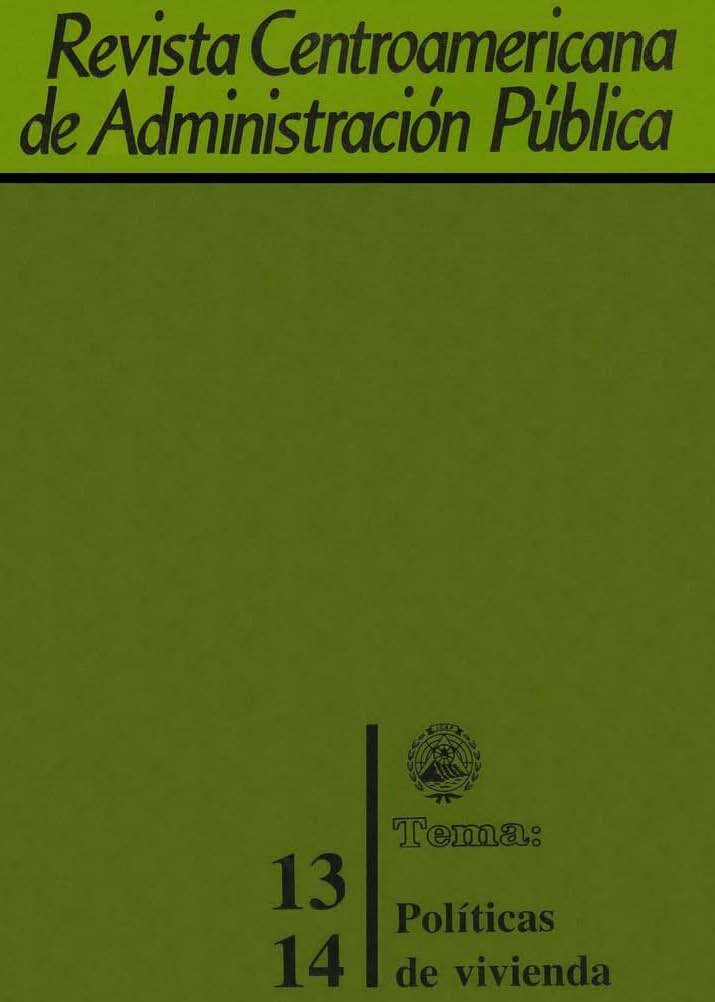
Housing policies
No. 13-14 (1987)The Central American region suffers from the age-old problem of poverty. Taking this major problem as part of the phenomenon that studies have lately called "State-Society Relations", the Central American Institute of Public Administration concluded, at the end of 1985, the research study "State, Policies and Critical Poverty in Central America: State, Policies and Critical Poverty in Central America.
The research was conceived to use the housing variable as an indicator of poverty, which allows us to introduce a subject intimately linked to the study of State-society relations: that of public policies. These are ultimately conceived as the adoption of a society with respect to certain problems.
Public policies were studied on the basis of the analysis of a specific problem such as housing. Nevertheless, the aim was to go beyond a micro-analytical approach to the problem and place it in the context of the political project of those who have exercised power; in such a way that the Political Regime is approached and seen as influencing and, in turn, influencing decision-making in general and the development and execution of public policies in particular.
Within this broad spectrum of the problem, we offer this special issue of the Revista Centroamericana with the purpose of putting on the table for discussion different ways to address this issue.
The magnitude of the housing shortage and insufficiency problem is such that, for example, in Costa Rica in 1986, the housing deficit reached 130,000 homes. The inability of the economic structure in the region to produce and finance housing is becoming more acute day by day. Several structural factors converge in this problem, two of which are fundamental: the process of population movements and their spatial distribution - a product of the transformations in the productive structure - and the existence of a total imbalance in the distribution of social income. This last phenomenon determines that a significant sector of the population is outside the housing market due to their meager purchasing power and their inability to save, so that the housing problem becomes one more indicator of their situation of poverty and marginality.